
How to Search Criminal Dockets
No official Gibson County page exposes one open search box for all trial-level criminal cases. A useful search begins with routing. Write down the defendant's full name, any alias, the approximate filing year, the court location, and the docket number if one appears on a notice. Do not assume a matter in Humboldt is in the same file channel as one in Trenton. The Gibson County Circuit Court Clerk is the starting point for Criminal and Circuit matters, while the General Sessions Court lists separate Trenton and Humboldt contact lines.
Tennessee Public Case History is not a substitute for a Gibson County criminal docket search. It covers cases at the Tennessee Supreme Court, Court of Criminal Appeals, and Court of Appeals after a trial matter reaches that level. Tennessee Case Finder may serve participating clerks, but Gibson coverage was not confirmed on an accessible official county page. Ask the clerk before relying on it.
- Identify the court from the warrant, citation, notice, or last order. Separate General Sessions from Criminal or Circuit Court.
- Give the clerk the defendant name, approximate year, location, and docket number. Ask whether a lower-court number changed after transfer.
- Confirm the current setting, charge status, and disposition through the clerk-held register. A prior docket row may no longer control.
- Inspect the file at the correct office when phone confirmation is not enough. Ask what identification and copy procedure apply.
- Order the judgment or disposition from the custodian when an official copy is needed. Use Public Case History only for an appeal.
Gibson Criminal Dockets Without a Portal
The lack of a countywide public portal changes the order of work, not the existence of the record. Call the Circuit Court Clerk at 731-855-7615 for Criminal or Circuit Court. General Sessions has a Trenton line at 731-855-7664 and a Humboldt line at 731-784-9551. Ask staff to confirm the court, location, last setting, and process for supervised inspection. If the case is not held there, ask which clerk has custody.
The statewide Tybera eFlex system is an electronic filing portal used by selected Gibson courts. It requires an account and connects filers with their associated matters. It is not an open Gibson County criminal docket index. A login page that lists courts should not be read as proof that every public case can be searched there.
When the search is urgent, use the court named on the most recent paper. A clerk can explain whether a result is absent because the matter is too new, filed under another location or number, transferred, restricted, or not part of that system.
Note: Confirm refresh timing and number formats with the clerk because Gibson County publishes no universal trial-court search specifications.
What a Criminal Docket Shows
A Gibson County criminal docket places each formal event in date order. The Tennessee Administrative Office of the Courts' TJIS criminal structure is the official field-level surrogate because no de-identified public Gibson docket sheet was found. It records location, filing, charge, classification, judgment, and disposition data. It does not publish a case's hearing calendar, financial balance, or linked documents through the manual itself. Those details must come from the clerk-held case register, latest order, or file.
| Docket number | The clerk's unique number, shown in the TJIS structure as a docket-number field; local formats vary, so confirm docket number + year with the clerk. |
|---|---|
| Location and filing | Location code, filing date, filing type, judge, and the court reporting the case. |
| Defendant | Name and alias fields; the TJIS structure also contains an SSN field that is not for public display. |
| Charge | Offense, misdemeanor or felony type, class A through E, T.C.A. section, count, amended section, and final offense. |
| Case result | Judgment, coded disposition, and disposition date. Read the filed order for the full legal result. |
The docket can point to a complaint, warrant, indictment, motion, judgment, or order without supplying the document image. Request that paper from the clerk. Do the same for bond, court-cost, restitution, or balance details because the inspected TJIS guide did not expose public amount fields.
Read Gibson Criminal Docket Codes
TJIS fields can be terse. SCN is a state case-number identifier used in criminal data entry. T.C.A. points to the Tennessee Code Annotated provision tied to a charge. A count is one separately numbered allegation. The M/F field marks misdemeanor or felony, while class A through E is used for felony classification. Each code supplies one piece of the entry, not the whole case result.
The official TJIS criminal instruction manual identifies disposition values that include acquittal, conviction after trial, dismissal or no prosecution, guilty plea, plea to a lesser charge, transfer or remand, diversion, return with an unapprehended defendant, bound over to grand jury, and returned or attended court.
- Bound over
- The lower-court stage sent the matter toward grand-jury review. It is not a conviction.
- Diversion
- A pretrial or judicial program path recorded as a disposition category, not necessarily a trial verdict.
- Nolle prosequi
- A charge ended without a conviction; the order and later history determine the precise effect.
- Capias
- A writ directing an officer to take a person into custody.
- Bond forfeiture
- Court action tied to a failure to meet bond or appearance terms.
The manual's screen is visible in an official Tennessee court source.
That field layout shows why a short code should be checked against the filed judgment and the next dated entry.
Stages on a Criminal Docket
A Gibson County criminal docket may start with a complaint, warrant, citation, or other filing. An initial appearance or arraignment can address the charge, rights, plea, and bond. General Sessions may then hold a setting or preliminary hearing. If a felony matter is bound over, the later docket can show grand-jury work, indictment, and transfer into Criminal or Circuit Court. Pretrial motions, plea or trial, judgment, and sentencing follow as the case requires.
Docket flow: Filing › Initial appearance › General Sessions review › Grand jury or transfer › Pretrial › Plea or trial › Judgment and sentencing.
Post-judgment rows may record probation work, appeal, expunction proceedings, or another court action. A bond forfeiture, capias, or failure-to-appear entry is a later event, not a summary of every prior step. Use the newest signed order and ask the clerk which setting is current.
Gibson Criminal Docket Court Routes
General Sessions is Gibson County's first-resort criminal court for criminal hearings, warrants, bonds, probation review, search warrants, and traffic work. Felonies that proceed past the lower-court stage belong in Criminal or Circuit Court. Juvenile allegations use a separate Juvenile Court records channel. Municipal courts retain city-ordinance and locally handled traffic matters unless a transfer or state-law route changes the court.
The county's General Sessions page documents its wide criminal role and both office channels.
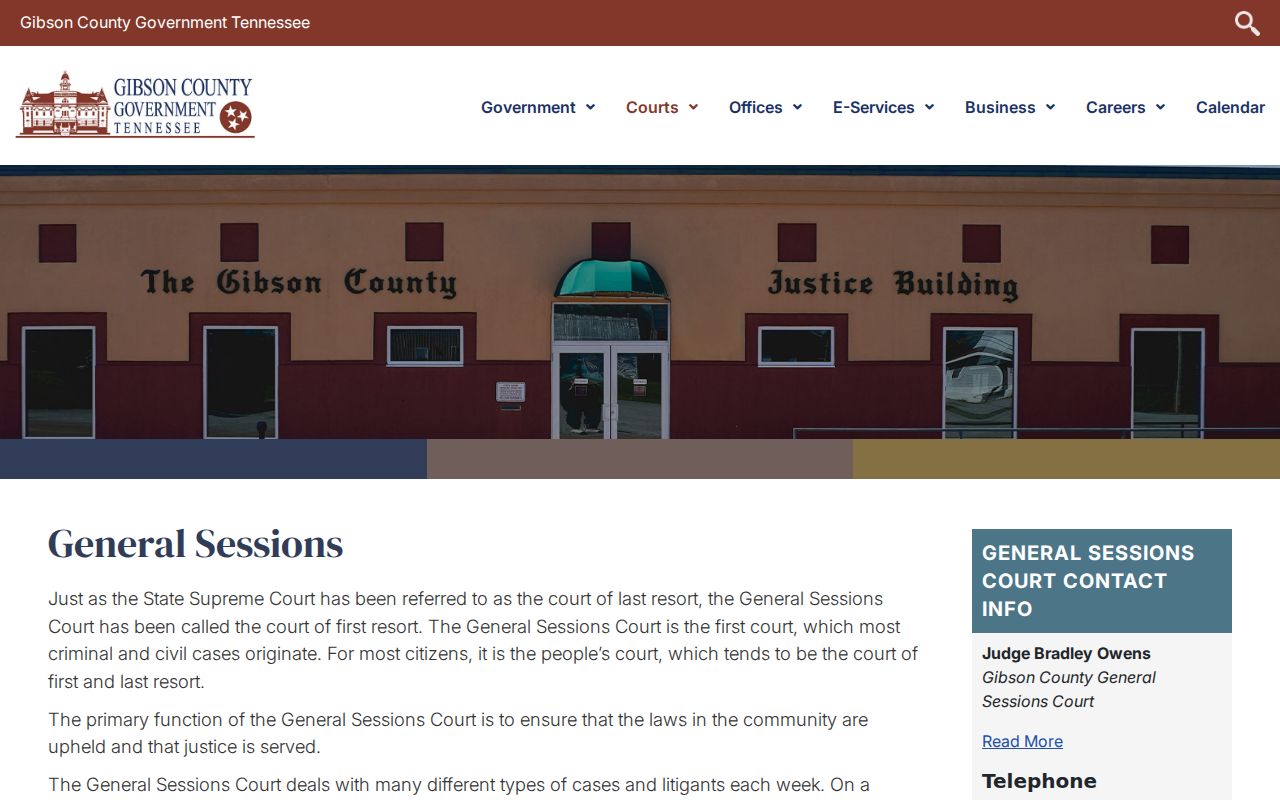
The court's own service list explains why a warrant, bond item, and preliminary setting may appear before any Criminal Court entry.
| Court | Criminal docket role | Contact route |
|---|---|---|
| Criminal/Circuit | Felony trials and criminal cases at the trial-court level | 295 N College, Trenton; 731-855-7615 |
| General Sessions | Warrants, bonds, first appearances, preliminary work, and other criminal hearings | Trenton 731-855-7664; Humboldt 731-784-9551 |
| Juvenile Court | Juvenile matters under separate access rules | 301 N College, Trenton; 731-855-7623 |
| City courts | Municipal ordinance and local traffic matters | Contact the issuing city's court clerk |
Gibson Juvenile Criminal Docket Route
Juvenile allegations do not use the ordinary adult Gibson County criminal docket path. The county lists Juvenile Court at 301 N College in Trenton with a separate administrator and phone line, 731-855-7623. Delinquency, dependency, neglect, and related child matters also carry confidentiality rules that can limit what a public search or counter request will disclose.
The official Gibson County Juvenile Court page is the correct first contact for that channel. Ask what proof of identity or authority is required. Do not send a juvenile request to the adult Criminal Court Clerk and then treat the lack of a result as proof that no proceeding exists.
For an adult case that began while a person was a juvenile or involved a transfer, ask the relevant clerks which court now holds the public portion. The transfer entry, court order, and access ruling control. The ordinary adult docket should not be used to infer facts from a protected juvenile file.
Which Court Holds Criminal Dockets
The Gibson County Circuit Court Clerk keeps the Circuit and Criminal records identified by the county. The clerk's Justice Building office is at 295 N College in Trenton and lists weekday hours of 8:00 a.m. to 4:30 p.m. General Sessions uses the same Trenton street address but has its own listed phone, plus the Humboldt channel. The office name matters as much as the building name when requesting a Gibson County criminal docket.
The official Circuit Court Clerk page identifies Cindy Flowers and the trial-court contact information.
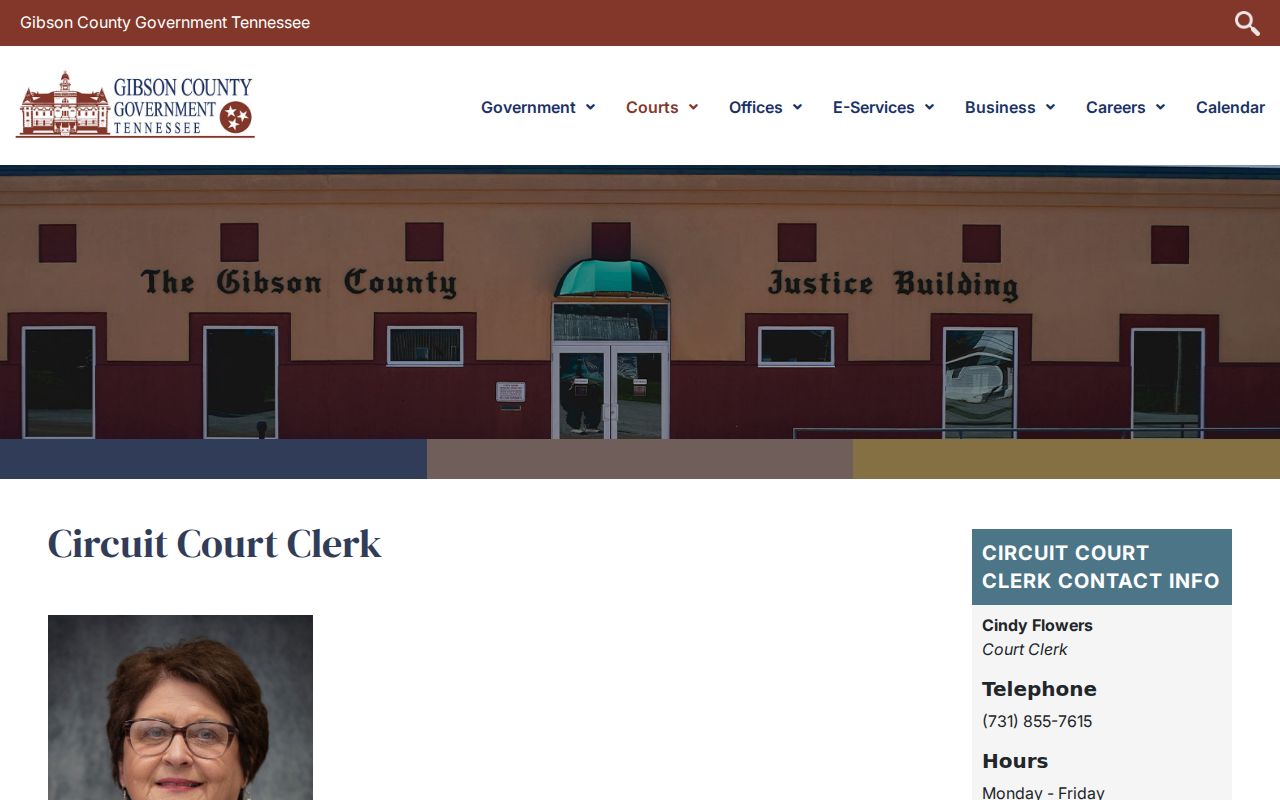
This clerk channel is the direct route for confirming a Criminal or Circuit docket and ordering its filed judgment.
Joyce Brown's Gibson County Clerk is a different constitutional office. That office handles county-government records, licenses, and vehicle or title services, not the main Criminal Court docket. Juvenile Court likewise has its own administrator and confidentiality rules. Correct routing avoids a false conclusion that no file exists.
Note: Give the clerk both the location and prior docket number because a transferred case can carry cross-references between stages.
Gibson Criminal Docket Count Context
The Administrative Office of the Courts' 2024–25 report separates Gibson and Gibson (Humboldt) location columns. For July 1, 2024 through June 30, 2025, the Gibson column records 456 criminal counts filed and 712 disposed. Gibson (Humboldt) records 215 filed and 217 disposed. These are counts, not case totals, and the report warns that totals may be incomplete if a month was missing. They describe court workload, not the likely result of any one matter.
The split reinforces a search lesson: preserve Trenton or Humboldt as a locator. The two locations should not be merged when reading the report or tracing the clerk channel.
Missing Gibson Criminal Docket Results
When a Gibson County criminal docket does not appear in an online system, check the court route before drawing a conclusion. First call the clerk named on the warrant, notice, or last order. Give both the old and current docket numbers if a transfer occurred. Ask whether the matter is filed at Trenton or Humboldt, whether it remains in General Sessions, and whether the public index has been updated.
If staff confirms that the file exists, ask whether the public may inspect the register or receive a redacted copy. Juvenile, sealed, expunged, and protected records follow different rules. An authorized filer may see an associated electronic case in eFlex while the public does not have the same view. An appeal may instead appear in Tennessee Public Case History after it reaches the Court of Criminal Appeals or Supreme Court.
Keep the question narrow: request the current status, next setting, disposition date, and title of the latest filed order. That set of facts lets the custodian answer without treating a portal's silence as the final word.
Public Access and Sealed Criminal Dockets
Tennessee Supreme Court Rule 34 begins with public access to court records, but access can be limited by statute, rule, protective order, or sealing order. A public Gibson County criminal docket may show a case number, court, dated entries, settings, and disposition. A document image can still be restricted or require a clerk request. Social Security numbers and other protected identifiers are not public display fields.
A missing result does not prove that no case exists. The record may be juvenile, sealed, expunged, too new for an index, held by another clerk, or excluded from a vendor system. Ask the custodian whether the file exists and whether a redacted public copy is available. A records request cannot override a sealing order or confidentiality law.
Key access rules:
Tennessee Supreme Court Rule 34 generally opens court case records unless a stated legal restriction applies.
The Tennessee Public Records Act guidance explains citizen inspection rights, identification, exemptions, and agency response duties.
For an official result, order the filed judgment or certified disposition from the clerk that keeps the Gibson County criminal docket. The docket code is a locator. The signed court paper is the fuller record.