
How to Search Civil Dockets
Gibson County does not publish one confirmed open civil docket search across Circuit, Chancery, and General Sessions. Begin with the complaint, summons, notice, or order. Record the party names, approximate year, docket number, and whether the file is tied to Trenton or Humboldt. The Circuit Court Clerk handles Circuit records. The Clerks and Masters keep Chancery files at separate Trenton and Humboldt offices, while General Sessions has its own civil channel.
Tybera eFlex supports electronic filing in Gibson-Trenton Circuit and both Gibson Chancery locations. It is a filer login, not a public countywide case index. Tennessee Case Finder may provide inquiry for participating Circuit and General Sessions Civil clerks, but official Gibson participation and coverage were not confirmed. Call the custodian before creating an account or treating either system as complete.
- Identify Circuit, Chancery, or General Sessions from the newest case paper. Preserve the Trenton or Humboldt location.
- Give the clerk the full party names, filing year, docket number, and case type. Ask whether another court or location now holds it.
- Request the current register entries, case status, next setting, and the title of the latest signed order.
- Inspect the file under the custodian's rules when the register alone does not answer the question.
- Submit the office's copy request and ask for certification when an authenticated judgment or order is required.
Gibson Civil Docket Court Routes
Civil work is divided by jurisdiction and subject. Circuit Court has general civil jurisdiction and hears appeals from lower courts. Chancery handles equity, estates and probate, domestic relations, judicial sales, and related matters described in the 28th Judicial District rules. General Sessions is locally described as the first court for many civil matters and handles possession writs. Juvenile Court keeps protected child and family matters on a separate records path.
| Venue | Civil work | Custodian channel |
|---|---|---|
| Circuit Court | General civil cases and appeals from lower courts | 295 N College, Trenton; 731-855-7615 |
| Chancery, Trenton | Equity, estates, probate, domestic relations, and related cases | 204 N Court Square; 731-855-7639 |
| Chancery, Humboldt | The same district Chancery jurisdiction at a second Gibson location | 1421 Osborne; 731-784-9551 |
| General Sessions | First-resort civil matters and possession writs | Trenton 731-855-7664; Humboldt 731-784-9551 |
| Juvenile Court | Child and family matters within juvenile jurisdiction | 301 N College, Trenton; 731-855-7623 |
No official Gibson source reviewed supplied a universal dollar line between General Sessions and Circuit. Use the filing court, current law, and clerk advice instead of assuming a threshold.
What a Civil Docket Shows
A Gibson County civil docket begins with its number, caption, filing type, court, location, and filing date. The 28th District Chancery rules require papers to carry the docket number, case style, nature of filing, counsel contact details, Tennessee registration number, signature, and certificate of service. A chronological register can then show service, motions, settings, orders, judgment, and later collection or appeal activity.
| Docket number | The clerk-assigned identifier; use docket number + court + location because no single public Gibson format was documented. |
|---|---|
| Parties | Plaintiff or petitioner, defendant or respondent, and counsel of record. |
| Filings | Complaint, petition, answer, return of service, motion, exhibit, or other filed paper. |
| Settings | Motion day, pretrial conference, trial, pass, continuance, and reassignment date. |
| Result | Signed order, judgment, dismissal, default, nonsuit, satisfaction, or appeal entry. |
The docket is an index to case activity. It may name a motion or order without providing its text. The clerk-held document controls when a short entry leaves doubt.
Discovery May Miss Gibson Dockets
An apparent gap in a Gibson County civil docket may reflect a local filing rule, not inactivity. Under the 28th District Chancery rules, discovery is generally not filed with the Clerk and Master unless it will be used or considered by the court. Parties can exchange questions, answers, requests, and other discovery without each item becoming a chronological public entry.
Look for motions about discovery, notices tied to a court hearing, or exhibits that were in fact presented. Do not infer that no discovery occurred merely because the register lacks each exchange. Likewise, a proposed order is not the same as an entered order. Confirm the signed and filed version with the Clerk and Master.
The 28th Judicial District Chancery rules are the source for these local docket and file practices.
Note: Ask for the filed motion or order by title and date when the docket label does not reveal its full effect.
Types of Civil Cases on the Docket
Gibson County civil dockets span more than one court and more than one kind of claim. Chancery rules expressly address estates, probate, domestic relations, parenting plans, judicial sales, uncontested matters, and other equity work. Circuit supplies the general civil trial route. General Sessions handles first-resort claims and possession matters. The correct clerk depends on where the action was filed, not on a broad label such as “civil case.”
- Contract, property, real-estate, and other general civil claims
- Estate, probate, trust, guardianship, and conservatorship matters in Chancery
- Domestic-relations, divorce, parenting, and support matters where public access is allowed
- Possession and other first-resort civil matters in General Sessions
- Appeals, transfers, post-judgment collection, and satisfaction activity
Adoption, juvenile, and protected family materials are not ordinary public civil records. The presence of a general case category does not open each pleading or exhibit.
Two Gibson Chancery Docket Offices
Gibson County has separate Chancery offices in Trenton and Humboldt. Katelyn Orgain is listed as Clerk and Master in Trenton at 204 N Court Square. Amanda Brown is listed at the Humboldt office, 1421 Osborne Street. The court sits within the 28th Judicial District, which also includes Crockett and Haywood counties. A district case may be heard at any of four Chancery courts, and the attorney of record bears responsibility for bringing the file to the proper court.
The official Trenton Chancery page shows the clerk channel, forms, local rules, and eFlex resources.
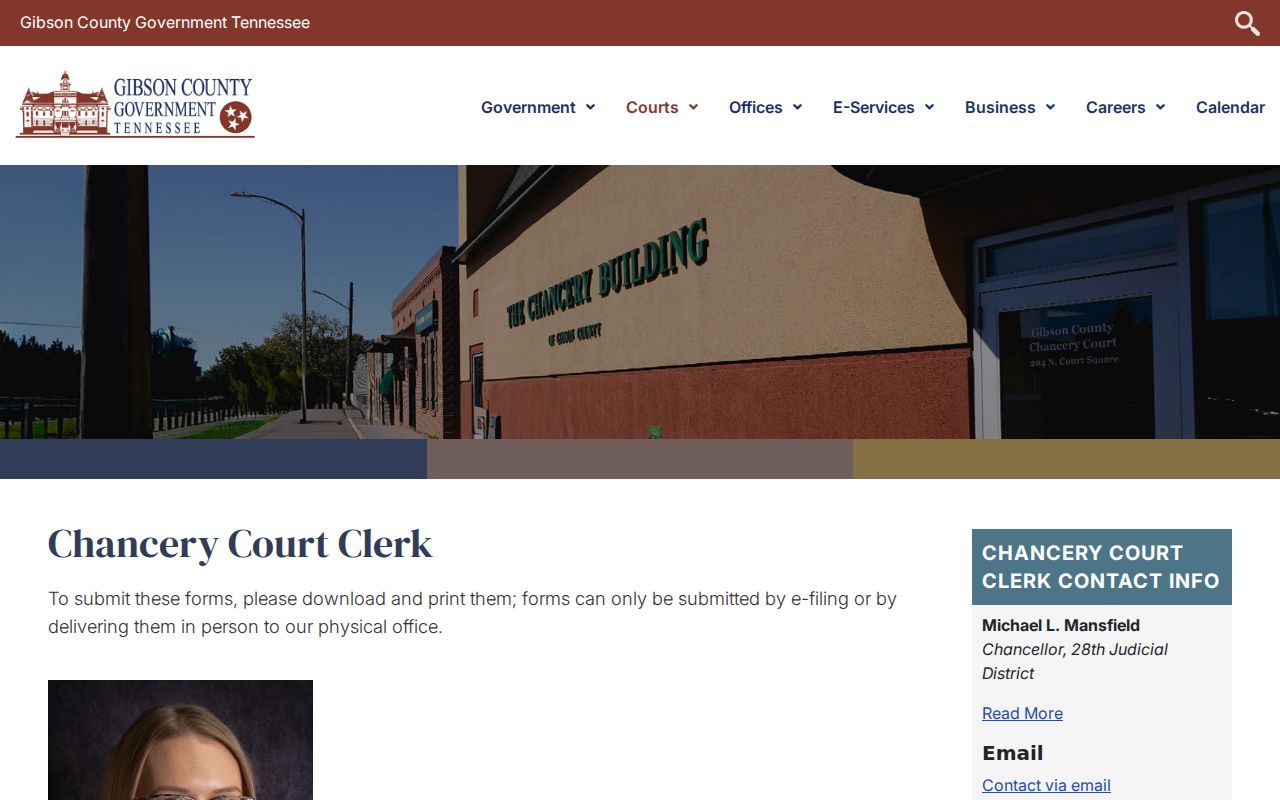
That office profile is a direct source for the Trenton custodian rather than a generic county records desk.
The Humboldt Chancery page identifies the second Gibson County civil docket location.
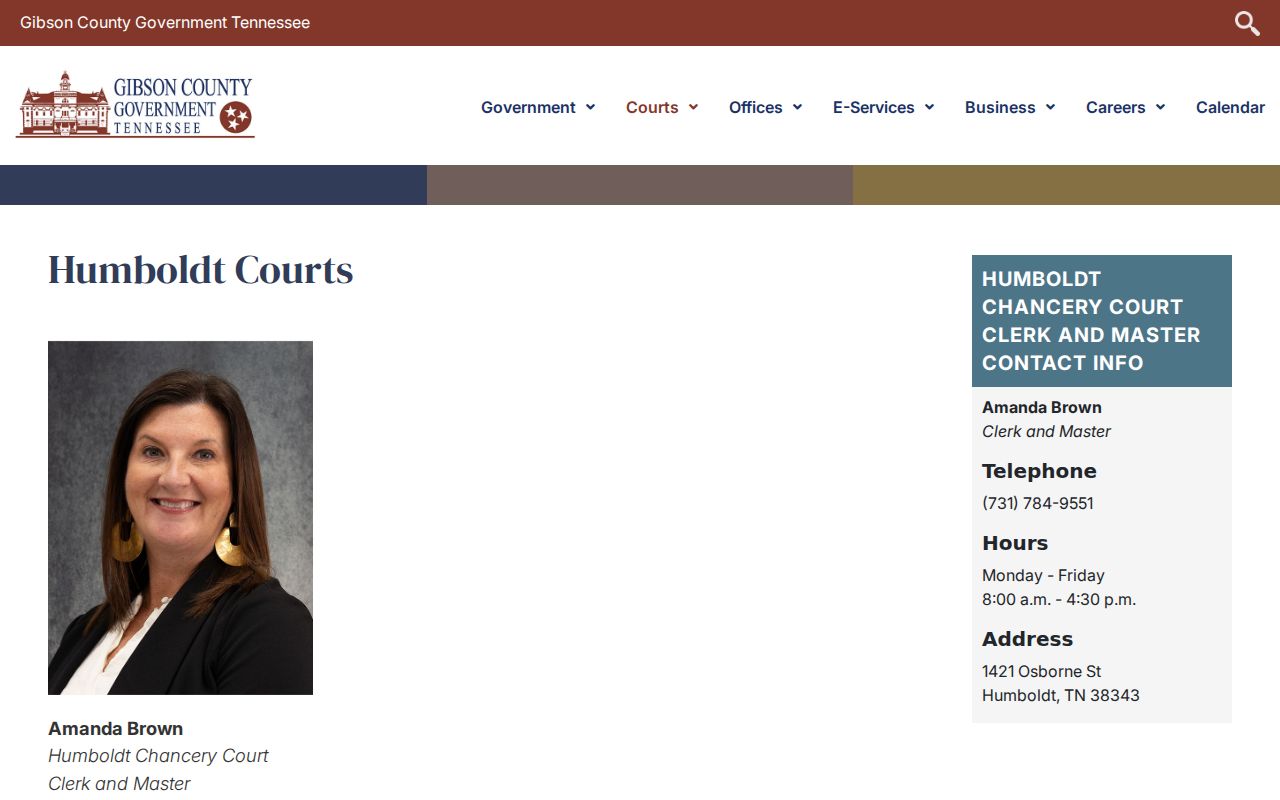
Its shared Osborne Street setting makes the location name a key part of every Chancery request.
Settings and Hearings on Civil Dockets
Chancery procedure gives a Gibson County civil docket a distinct rhythm. The Clerk and Master places a case on the motion-day calendar 90 days after filing. If the matter is not resolved at that first setting, it becomes a pretrial conference and the court sets trial. Regular sessions start at 9:00 a.m. unless the court directs otherwise. Trenton sessions for motions and related work recur on the first and third Fridays, while Humboldt uses the second and fourth Fridays.
A continuance requires leave of court and good cause. The local rules call for a written motion with an affidavit five days before trial. When a case is passed, a written order must state the reason, who sought the pass, and the reassignment date. Thus, an old calendar entry is not proof of the current setting. Read the latest signed order and confirm with the calendar clerk or Clerk and Master.
The full county date workflow is available in the Gibson County court calendar. The docket and the signed setting order remain the case-specific sources.
Gibson Civil Docket Filing Records
The AOC Chancery filing report keeps Trenton and Humboldt as separate location columns. For 2024–25, Gibson/Trenton shows 121 total filings and 135 dispositions. Gibson (Humboldt) shows 574 filings and 553 dispositions. The Humboldt filing column includes 203 probate or trust matters, 164 residential parenting or child-support matters, 59 divorces without minor children, 48 divorces with minor children, 39 miscellaneous civil matters, and 21 conservatorship or guardianship matters.
The official Chancery filings report supplies that context.
The table highlights why location and case type are strong locators, but the totals should never be used to predict an individual result.
Public Access to Civil Dockets
Tennessee Supreme Court Rule 34 generally opens court case records unless a statute, rule, protective order, sealing order, or protected judicial function limits access. A Gibson County civil docket may remain public while one exhibit or identifier is redacted. Juvenile, adoption, dependency, and other protected family material require a separate access decision. Ask the custodian whether a redacted copy can be inspected instead of assuming the whole case is closed.
Gibson Chancery's records policy allows oral inspection requests. Copy requests use written Form A and citizenship identification. The policy permits pickup, mail, electronic, or other delivery and says a response is due within seven business days when prompt production is not practical. It lists copy and labor charges, while Circuit and General Sessions fees must be confirmed with their clerk.
Key access rules:
Tennessee Supreme Court Rule 34 sets the court-record access baseline and recognizes lawful restrictions.
The Tennessee Public Records Act guidance explains citizen inspection, identification, exemptions, and response duties.
Inspection must remain under clerk supervision, and the file cannot be withdrawn without court authority. Request the entered judgment when the Gibson County civil docket only names it.
Gibson Civil Docket Time Standard
The 28th District local rules direct Chancery cases to be concluded or set for trial within twelve months unless the court orders more time. That is a case-management standard, not a promise that each Gibson County civil docket will end within one year. A complex matter, a continuance for good cause, or a court order can change the course.
The rules also permit docket-clearing action when a required order is not filed. An order dismissing for failure to prosecute may appear after a party does not move the case forward as required. Read the signed order before labeling the result. A dismissal, nonsuit, default judgment, agreed order, and satisfaction of judgment have distinct meanings and should not be treated as the same endpoint.
- Default judgment
- A judgment entered after a party fails to respond or appear as required.
- Nonsuit
- A plaintiff's or petitioner's voluntary termination, subject to Tennessee procedure and the entered order.
- Satisfaction
- A later record that an entered judgment has been satisfied.
The most reliable chronology pairs the register with the latest filed order. Calendar goals explain the pace, while the order explains what the court did.
Gibson Civil Docket Fax Filings
A fax charge can be mistaken for a copy fee. Tennessee Rule of Civil Procedure 5A.04 sets a $5 service charge plus $1 for each page, including the cover sheet, for a fax filing. Payment is due within ten calendar days. That charge concerns sending a paper into the court file by fax. It is not the price for obtaining a docket sheet or ordinary copy.
The official fax-filing rule states the service charge.
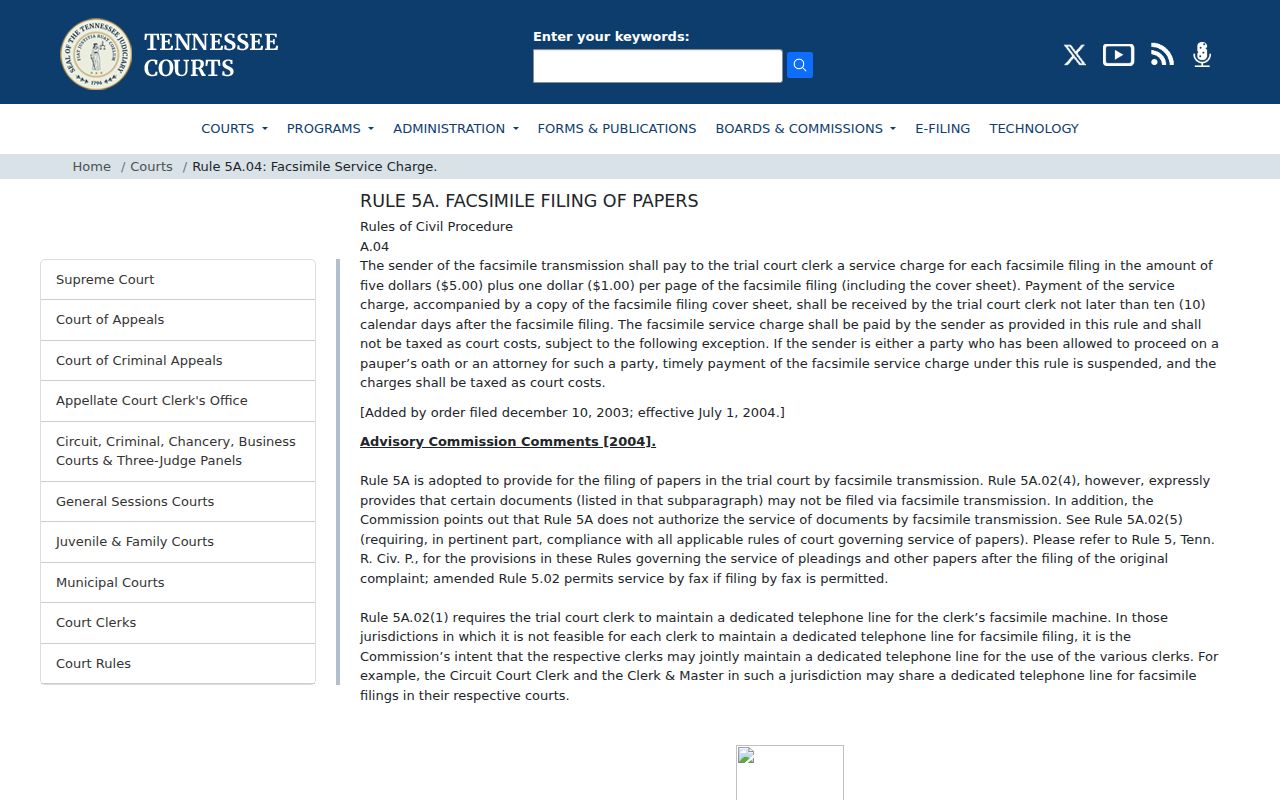
This distinction keeps filing costs separate from the Chancery records policy's per-page copy rate.
For a plain Chancery copy, the local policy lists $0.50 per page, a $5 CD, labor at $14.30 per hour after the first hour, a 3 percent card fee, and prepayment when the estimate exceeds $50. The policy body says inspection is free, while Form A prints a $5 inspection choice. Confirm that conflict before payment. No separate certification price was documented.
Note: Ask for a written estimate and state whether the request is for inspection, a plain copy, or a certified judgment.